
Janitorial Service Contract Negotiation Tips for 2026

Table of Contents
Step 1: Build Your Janitorial Services Contract Checklist Before Negotiating
Step 2: Decode Commercial Cleaning Contract Terms That Affect Your Bottom Line
Step 3: Use a Janitorial Services Agreement Template to Compare Proposals
Step 4: Negotiate the Janitorial Service Pricing Structure Line by Line
Negotiate labor assumptions first
Treat supplies and equipment as a pass-through or a fixed line, not both
Negotiate frequency and add-ons separately
Handle escalation, overtime, and change orders up front
Trade concessions instead of giving them away
Step 5: Define Scope, Service Frequency, and Quality Standards in Writing
Step 6: Negotiate Renewal, Termination, and Transition Terms
Renewal: kill the auto-renewal trap
Termination: separate termination for cause from termination for convenience
Transition: write down the handover duties
Protect against a service gap
Step 7: Avoid These Red Flags During Contract Review
Frequently Asked Questions
Last Updated: October 18, 2026
Step 1: Build Your Janitorial Services Contract Checklist Before Negotiating
A janitorial service contract is a written agreement that defines what a cleaning provider will do, how often, at what standard, and at what price.
At RC Cleaning Services, LLC, we know the importance of clear contracts to avoid disputes over scope, surprise add-on invoices, and unreliable cleaning crews.
Your pre-negotiation checklist should cover:
Scope of work, room by room and surface by surface
Service frequency and cleaning schedule
Quality standards and inspection checklist
Walk into every negotiation with this list in hand. It gives you use, because you're asking specific questions instead of vague ones.
Pro Tip Ask each provider to quote against your checklist, not their own template. Comparing bids built on the same scope is the only way to spot a lowball number.
Step 2: Decode Commercial Cleaning Contract Terms That Affect Your Bottom Line
Commercial cleaning contract terms hide costs in plain sight. The words look standard. The money leaks out later.
Watch these terms closely:
"Periodic" or "as needed" tasks. These have no fixed frequency, so you can't budget for them.
"Normal wear" exclusions. Vague enough to excuse almost any miss.
Escalation clauses. A small annual increase compounds fast over a multi-year deal.
The U.S. Small Business Administration's contract guidance is a solid primer on reading business agreements before signing. It won't cover cleaning specifics, but it teaches you to question every clause.
A common mistake is treating the proposal as the contract. They are different documents. The proposal sells. The contract binds. Negotiate the contract.
Step 3: Use a Janitorial Services Agreement Template to Compare Proposals
A janitorial services agreement template is a standard contract framework you use to line up competing proposals against identical terms. It turns a stack of glossy bids into an apples-to-apples comparison.
Here's how to use one:
Pull a free commercial contract template from a reputable legal source.
Fill in your scope, schedule, and quality standards.
Send the same template to every provider.
Require written responses to each section.
Score responses side by side.
This approach exposes providers who pad their bids with vague language. It also protects you, because every bidder works from the same baseline. The FTC's guidance on advertising and pricing claims reminds businesses that quoted terms must be accurate, so hold every proposal to that standard.
Template Section | What to Compare | Why It Matters |
Scope of work | Room-by-room detail | Prevents add-on invoices |
Frequency | Tasks per week/month | Drives labor cost |
Quality standards | Inspection checklist | Sets pass/fail |
Pricing | Line-item breakdown | Reveals hidden fees |
Renewal terms | Auto-renew or fixed | Controls lock-in |
Step 4: Negotiate the Janitorial Service Pricing Structure Line by Line

The janitorial service pricing structure should be broken into labor, supplies, frequency, and add-on services. Ask for that breakdown in writing.
Most bidders will hand you one monthly figure. Push back and request a line-item schedule with these columns: task, frequency, labor hours per visit, hourly burdened rate, supply cost, equipment cost, and monthly subtotal.
Negotiate labor assumptions first
Labor is typically the largest line, so it deserves the most scrutiny. Ask three questions for every task:
How many hours per visit? A provider quoting 2.5 hours for a 10,000-square-foot office is either fast or cutting corners. Ask them to walk you through the task list and time assumptions.
What is the burdened hourly rate? That is the wage plus payroll taxes, insurance, and supervision overhead, not the wage alone. A rate that looks low often hides a thin staffing model.
How many visits per week? Fewer, longer visits usually cost less per square foot than many short ones because travel and setup time drop. Test this: ask for a quote at three visits per week and at two longer visits, same total hours, and compare.
A simple way to sanity-check a bid: multiply hours per visit by visits per month by the burdened rate, then add supplies. If the total is far below the monthly price, the difference is margin, overhead, or tasks the provider plans to skip.
Treat supplies and equipment as a pass-through or a fixed line, not both
Ask whether supplies are fixed (a set monthly amount) or passed through (billed at cost plus a markup). Each has a trade-off:
Fixed pricing protects your budget but can lead to diluted chemicals or skipped restocking when costs rise.
Pass-through keeps quality up but exposes you to price swings and markup games.
Pick one and write it in. If you choose pass-through, cap the markup and require itemized receipts. If you choose fixed, specify product brands or dilution standards so the provider cannot quietly downgrade.
Negotiate frequency and add-ons separately
Cutting one visit per week often saves more than shaving the hourly rate, because you remove a full mobilization. Price window cleaning, carpet extraction, floor stripping and waxing, and post-construction cleans as separate line items with their own frequencies. That way you can add them seasonally without renegotiating the base contract, and you can see whether the provider is inflating the base fee to subsidize add-ons.
Handle escalation, overtime, and change orders up front
Three pricing mechanisms cause most post-signing disputes:
Escalation. Cap annual increases at a stated percentage or tie them to a published index, and require written notice before any increase applies. An uncapped 4% annual escalator on a three-year deal compounds to roughly 12.5% over the term.
Overtime and emergency calls. Set a pre-approved overtime rate and define what triggers it (after-hours spills, event cleanup). Otherwise every emergency becomes a negotiation.
Change orders. Require written, priced change orders before any work outside the scope begins. No verbal approvals, no surprise invoices.
Trade concessions instead of giving them away
A common pattern in successful negotiations: never concede a price point without getting something back. If the provider asks for a higher rate, trade for a longer term, a reduced notice period, added periodic tasks, or a service-credit clause. Keep a simple priority list before you sit down, must-haves, nice-to-haves, and walk-away items, so you know which concessions are cheap for you and valuable to them.
Watch Out Never accept a verbal discount. If a provider drops the price to win the deal, get the new number written into the contract with the same scope and the same line-item schedule. Otherwise the scope quietly shrinks to match the discount. Ask every bidder to price the same scope at two frequencies (for example, three visits versus two longer visits per week). Comparing those two numbers reveals how much of the price is labor versus mobilization, and where the real negotiating room is.
Step 5: Define Scope, Service Frequency, and Quality Standards in Writing
Scope of work, service frequency, and quality standards are the three clauses that decide whether you get a clean building or a fight. Write all three in specific, measurable language.
Use this structure:
Scope of work: List every area and task. "Restrooms: disinfect fixtures, restock supplies, mop floors" beats "clean restrooms."
Service frequency: State exact counts. "Three visits per week" beats "regular service."
Quality standards: Attach an inspection checklist with pass/fail criteria. Include a re-clean window if a task fails.
This is where a service-level agreement earns its keep. Tie performance expectations to a measurable checklist, and require the provider to correct failures within a set time. The OSHA's cleaning and workplace safety standards also matter here: confirm the provider follows safety requirements and worker protection rules for the chemicals they use.
Step 6: Negotiate Renewal, Termination, and Transition Terms
Renewal and termination terms decide how easily you can walk away. Negotiate them before you sign, not after, because once the term starts, your leverage is gone.
Renewal: kill the auto-renewal trap
Automatic renewal is the most common lock-in mechanism in cleaning contracts. The clause usually reads that the agreement renews for another term unless either party gives written notice 30, 60, or 90 days before the end date. Miss the window and you are committed for another year.
Negotiate one of these instead:
Fixed term with an opt-out. A stated end date with your right to renew, not an automatic rollover.
Auto-renewal with a short notice window. If the provider insists on auto-renewal, push the notice period down to 30 days and put the renewal date on your calendar.
Capped renewal pricing. Require written notice of any increase at least 60 days before renewal, and cap the increase at a stated percentage.
Termination: separate termination for cause from termination for convenience
These are different rights and you need both:
Termination for cause covers poor performance, insurance lapse, or safety violations. It should take effect after a short cure period, typically 10 to 30 days, during which the provider can fix the problem. A cure period protects you from arguing about whether a single missed task justifies exit.
Termination for convenience lets you exit without cause on a set notice period, often 30 to 60 days. Expect to pay for services rendered through the notice date, and sometimes an early-termination fee. Negotiate that fee down or out.
Also negotiate service credits: a stated credit or re-clean obligation when inspection scores fall below the agreed threshold. Credits turn a vague quality promise into a financial consequence, which is far more enforceable than a sternly worded clause.
Transition: write down the handover duties
When you change providers, the outgoing crew controls keys, access codes, cleaning logs, supply inventories, and equipment. If the contract does not require handover, you can face a service gap while the new provider waits for access.
Require the outgoing provider to:
Return all keys, fobs, and access codes within a stated number of days of the end date.
Deliver cleaning logs, inspection records, and supply inventories.
Cooperate with a reasonable transition period, including overlapping coverage if needed.
Protect against a service gap
Schedule the new provider's start date before the old contract ends, and build in a short overlap if the building cannot go a day without cleaning. Confirm the new provider has insurance certificates and background checks completed before day one, not after.
Key Takeaway The best time to negotiate an exit is before you are stuck. A short notice period, a defined cure period, service credits, and written handover duties protect you more than any discount. If a provider refuses all termination flexibility, treat that as a signal about how they will handle problems later. Put every renewal and notice date into a shared calendar with reminders 90, 60, and 30 days out. Most lock-ins happen because nobody was watching the date, not because the terms were unfair.
Step 7: Avoid These Red Flags During Contract Review
Contract review is where you catch the problems. Some red flags are obvious. Others hide in fine print.
Watch for:
No written scope. If it isn't written, it isn't covered.
Auto-renewal with long notice. You'll miss the window and get locked in.
No inspection checklist. No standard means no accountability.
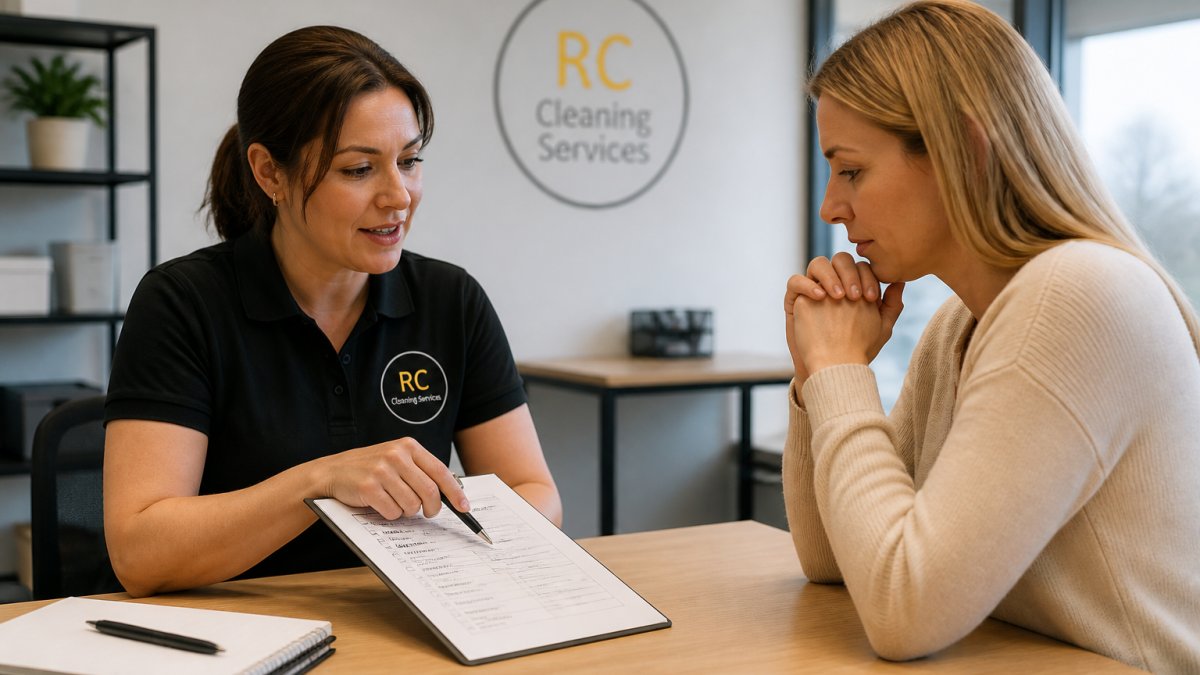
At RC Cleaning Services, LLC, we provide accurate project estimates through personal consultations, ensuring high-quality cleaning standards and reliable service delivery. This professional and approachable approach helps build trusted, long-term relationships.
Frequently Asked Questions
What should be included in a janitorial services contract?
A solid janitorial services contract should cover scope of work, cleaning schedule, service frequency, quality standards, pricing and payment terms, start and end dates, renewal and termination clauses, and responsibilities of both parties. It should also list any exclusions and additional services. Use a janitorial services contract checklist to make sure nothing is missing before you sign.
How do you negotiate a janitorial service contract?
Start by preparing a detailed checklist and gathering multiple proposals. Compare commercial cleaning contract terms side by side, focusing on the janitorial service pricing structure, scope, and service frequency. Negotiate line by line, ask for clarification on vague terms, and propose measurable quality standards. Be clear about your budget and priorities, and don't be afraid to walk away if key terms are unfavorable.
What are red flags in a janitorial services agreement?
Watch for vague scope descriptions, missing quality standards, unusually low pricing that may signal skipped tasks, automatic renewal clauses with long notice periods, and unclear termination fees. Also check for hidden additional service charges and lack of insurance or worker protection requirements. A thorough contract review can catch these issues early.
How should janitorial services be priced in a contract?
Pricing should be transparent and broken down by labor, supplies, and frequency. Ask for a detailed janitorial service pricing structure that separates base services from additional services. Clarify billing cycle, payment terms, and any escalation clauses. Avoid lump-sum pricing without a clear scope, as it makes it hard to compare proposals or negotiate changes.
Signing a janitorial service contract shouldn't feel like a gamble. The right provider gives you clear scope, honest pricing, and terms you can actually exit. At RC Cleaning Services, LLC, we back every agreement with accurate project estimates through personal consultations, reliable and timely service delivery, and rigorous quality assurance. Get started with RC Cleaning Services, LLC and negotiate a cleaning contract that protects your building and your budget.
BOOK ONLINE

Comments