
How to Ensure Quality in Commercial Janitorial Work

Table of Contents
Step 1: Define Quality Standards Before the First Walkthrough
Step 2: Build a Commercial Janitorial Scope of Work Template That Closes Loopholes
Line Items Every Scope Should Include
Frequency, Response Times, and Exclusions
Step 3: Turn Your Janitorial Quality Assurance Checklist Into an Inspection Routine
How Often to Run Site Audits
Scoring Systems That Actually Drive Consistency
Digital Checklists vs. Paper Forms
Benchmark Thresholds That Trigger Action
Calibrating Inspectors So Scores Mean the Same Thing
Step 4: Track Commercial Cleaning Performance Metrics That Matter
The Four KPI Categories Every Program Needs
Metrics for Quality, Responsiveness, and Staff Retention
Benchmark Ranges to Compare Against
Reporting Cadence and Who Sees What
Connecting Metrics to the Tools That Capture Them
Step 5: Run Post-Inspection Remediation Without the Blame Game
Step 6: Match Your Budget to the Quality Level You Actually Need
Step 7: Resolve Vendor-Client Conflicts Before They Cost You a Contract
Conclusion: Quality Is a System, Not a Promise
Frequently Asked Questions
Last Updated: October 4, 2026
Step 1: Define Quality Standards Before the First Walkthrough
Quality in commercial janitorial work starts before anyone touches a mop, with a written definition of what "clean" means for your building.
A quality standard is a written, measurable description of the condition a space must be in after each service visit.
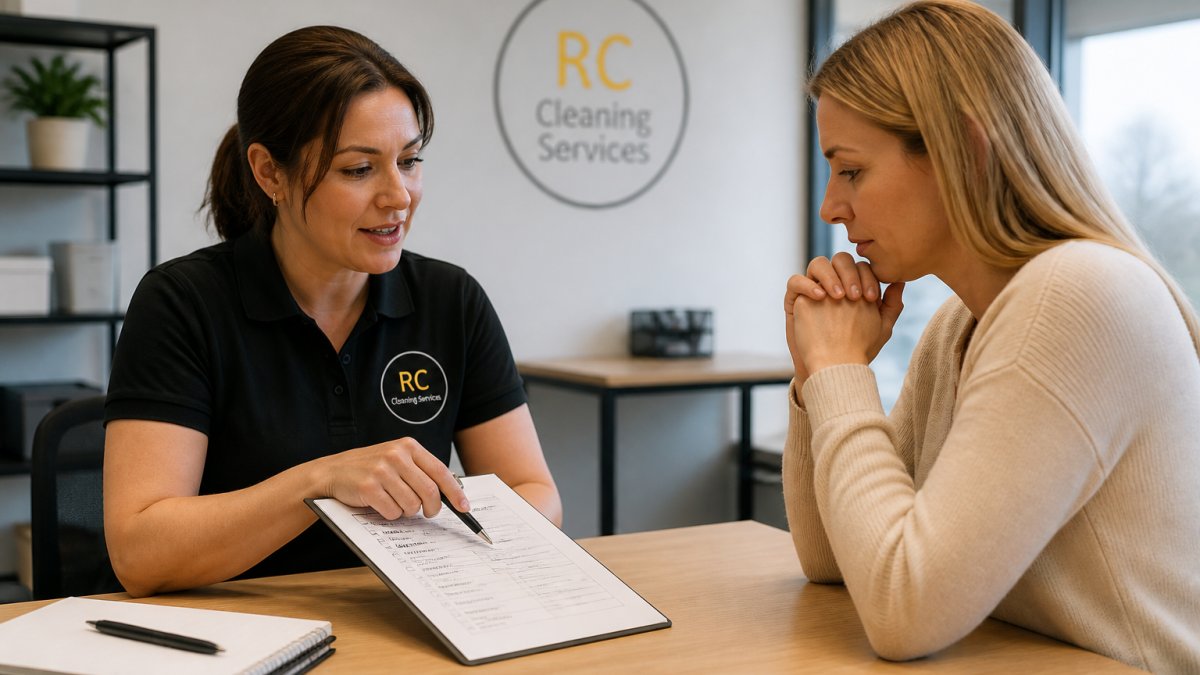
At RC Cleaning Services, LLC, we build standards through a personal consultation and a walkthrough of the actual space, not a generic form.
Start with three questions:
What does a failed inspection look like to you?
Which areas generate the most complaints?
What condition must the space be in for your business to open on time?
Write the answers down; they become the baseline every later step measures against.
Pro Tip Photograph the "acceptable" condition of two or three problem areas on day one. Photos end more arguments than any written clause, because both sides can see the same target.
Step 2: Build a Commercial Janitorial Scope of Work Template That Closes Loopholes
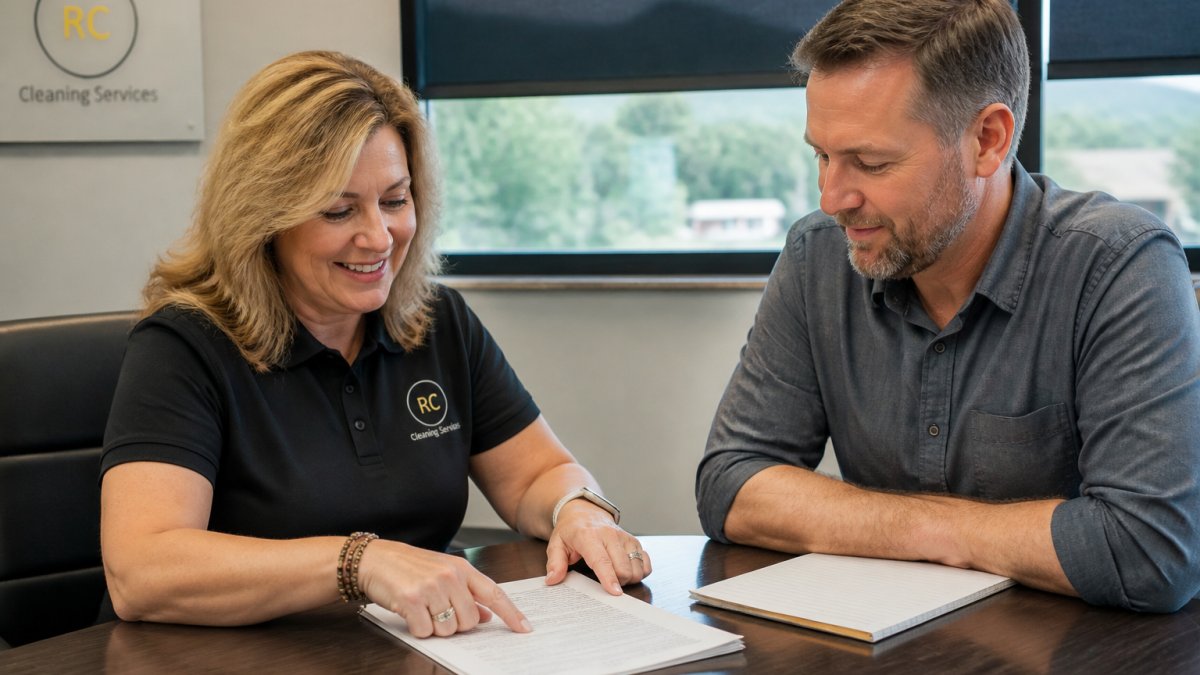
A commercial janitorial scope of work template lists every task, how often it happens, and what is excluded. It is the single most important tool for ensuring quality in commercial janitorial work, because it removes the "that wasn't included" conversation entirely.
Most service failures are scope failures: the crew did what the contract said, but the contract didn't say much.
Line Items Every Scope Should Include
Build your template around these categories:
Daily tasks: trash removal, restroom cleaning and restocking, spot mopping, entry glass
Weekly tasks: vacuuming under furniture, detail dusting, floor buffing
Monthly or quarterly tasks: carpet extraction, high dusting, vent covers, baseboards
Frequency, Response Times, and Exclusions
Frequency is where budgets and expectations collide: a lobby cleaned twice a day looks different from one cleaned twice a week, and the scope should say which one you bought.
A service level agreement sits on top of the scope: the scope lists tasks, the agreement lists consequences and remedies when tasks are missed, and both should reference each other.
Watch Out A scope without exclusions is a trap. The client assumes everything is covered; the vendor assumes nothing extra is. That gap produces the first dispute, usually within 30 days.
Step 3: Turn Your Janitorial Quality Assurance Checklist Into an Inspection Routine
A janitorial quality assurance checklist is a scored, repeatable inspection form tied to your scope of work. It only creates value when someone runs it on a fixed schedule, with the same scoring logic every time.

How Often to Run Site Audits
Weekly walkthroughs catch drift before it becomes a pattern; monthly audits go deeper into restroom fixtures, floor edges, high dusting, and storage. Add one unannounced spot check per month, scheduled inspections produce scheduled results, and the unannounced visit tells you the truth.
A workable cadence most facility managers land on:
Daily: crew self-check at end of shift using a short 5-item form (restrooms, trash, entries, floors, restock)
Weekly: supervisor walkthrough of every zone on the scope, scored
Monthly: deep audit of high-dusting, floor edges, vents, and storage
Scoring Systems That Actually Drive Consistency
Score each area from 1 to 5 against the written standard: 3 is acceptable, and anything below 3 triggers a fix within a set window. Keep the form to ten to fifteen line items; a forty-item form gets skimmed.
Restrooms: fixtures, floors, restocking, odor
Entries and lobbies: glass, floors, mats, trash
Offices and common areas: dusting, vacuuming, surfaces
Digital Checklists vs. Paper Forms
Paper forms work for small portfolios, but past two or three buildings they cost you in lost forms, inconsistent scoring, and no trend data. Digital inspection tools solve those problems, and common options fall into three buckets:
General-purpose form builders (for example, Jotform, Google Forms, Microsoft Forms), cheap, flexible, but no photo-to-issue workflow and no automatic trend reporting
Field service management platforms (for example, Janitorial Manager, CleanTelligent, TEAM Software), built for the industry, with photo capture, GPS-stamped inspections, and client portals
CMMS platforms (for example, UpKeep, Fiix, Limble), heavier, better suited to facilities that also track assets and work orders
Whichever you pick, the checklist logic should match the scope line by line: if the scope says "restroom restock to par level," the checklist item should read the same way, not "restrooms clean."
Benchmark Thresholds That Trigger Action
A score without a threshold is just a number. Set three bands in the service level agreement:
Green (4.0-5.0): acceptable, no action
Yellow (3.0-3.9): note the area, re-check next visit
Red (below 3.0): written remediation request within 24 hours, re-inspection within 48 hours
Track scores over time. One bad week is noise. Three bad weeks in the same area is a training or staffing problem, and it needs a different fix.
Pro Tip Photograph the same three angles in every restroom on every inspection. Same angle, same lighting, same time of day. Comparing apples to apples is what makes trend data usable.
Calibrating Inspectors So Scores Mean the Same Thing
Two inspectors scoring the same restroom differently is the fastest way to lose credibility with a vendor. Once a quarter, have two people score the same three areas independently, compare notes, and reconcile any line item that differed by more than one point. Adjust the written standard if the disagreement is real, not just a scoring habit.
Step 4: Track Commercial Cleaning Performance Metrics That Matter
Commercial cleaning performance metrics tell you whether the system works. Without them, quality is an opinion.
The Four KPI Categories Every Program Needs
Most quality programs track too many numbers and act on too few. Group metrics into four categories and pick one or two per category:
Quality: inspection score average, first-time-right rate (issues fixed on the first re-service)
Responsiveness: on-call response time, complaint acknowledgment time, remediation close-out time
Reliability: on-time arrival rate, missed-visit count, restock outage count
Metrics for Quality, Responsiveness, and Staff Retention
Track a small set and review it monthly:
Metric | What It Measures | How to Track |
Inspection score average | Cleaning consistency | Weekly checklist scores |
First-time-right rate | Remediation effectiveness | Re-inspections passed on first try |
Complaint volume by area | Weak spots | Log every complaint by location |
Response time to on-call requests | Responsiveness | Timestamp request vs. arrival |
Restock outages | Supply management | Count of empty dispensers found |
On-time arrival rate | Reliability | Sign-in log vs. scheduled start |
Crew turnover | Staff retention | Departures per quarter |
That last row is the one most facility managers skip, and it is a mistake: high turnover shows up as inconsistent results long before it shows up on an inspection form, because new staff miss details experienced staff know by habit. Also avoid tracking only complaints, complaints measure failure, not performance. Inspection scores measure performance.
Benchmark Ranges to Compare Against
Exact targets depend on building type and service tier, but most well-run programs land in these ranges:
Inspection score average: 4.0 or higher on a 5-point scale
First-time-right rate: 85% or higher
On-call response time: same business day for Tier 1 areas
Treat these as starting points, not absolutes. A medical office and a warehouse will not share the same targets, and the service level agreement should state the numbers you actually agreed to.
Reporting Cadence and Who Sees What
Metrics only change behavior when they reach the right people on a schedule:
Weekly: supervisor sees inspection scores and open remediation items
Monthly: facility manager and vendor account manager review the full KPI dashboard together
Quarterly: leadership sees trend lines, not single data points, plus any scope or budget changes the trends justify
Keep a one-page dashboard. If it takes more than five minutes to read, it will not get read.
Key Takeaway If you track one thing, track inspection scores by area over time. If you track two, add first-time-right rate. Trends tell you where to spend your attention. Single scores just tell you about one Tuesday.
Connecting Metrics to the Tools That Capture Them
Every metric needs a source: inspection scores from your checklist tool, response times from your work-order system, turnover from the vendor's HR reporting, which you should ask for in the service level agreement. If a vendor cannot produce a number on request, treat that as a data point in itself.
Step 5: Run Post-Inspection Remediation Without the Blame Game
Remediation is the step most quality programs skip entirely. Write a short workflow and follow it every time:
Log the issue with the inspection date, area, and score
Assign an owner and a fix-by deadline, usually 24 to 48 hours
Re-inspect the specific area after the fix
Record the outcome next to the original issue
If the same issue repeats twice, escalate to a training review
The point is not to find fault but to close the loop, a missed restroom restock is a process problem until proven otherwise. Keep the tone factual: "The second-floor restroom scored a 2 on Thursday; here is the photo and the re-inspection date" moves faster than any argument about effort.
Step 6: Match Your Budget to the Quality Level You Actually Need
Every quality level has a cost, and pretending otherwise wastes everyone's time.
A high-traffic medical office needs disinfection protocols and frequent restroom service. A low-traffic storage facility may only need weekly attention.
Map each area of your building to a service tier:
Tier 1, critical: restrooms, entries, break rooms. Highest frequency, strictest standards.
Tier 2, standard: offices, hallways, common areas. Routine frequency.
Tier 3, periodic: storage, stairwells, exterior glass. Scheduled, not daily.
We give accurate project estimates through personal consultations because a phone quote without a walkthrough is a guess.
Ask any provider to break the quote down by tier.
Step 7: Resolve Vendor-Client Conflicts Before They Cost You a Contract
Most vendor conflicts are not about cleaning. They are about unspoken expectations.
Resolve them with a short, scheduled conversation, not an email chain. A monthly or quarterly review meeting gives both sides a place to raise issues before they harden.
Use this structure:
Facts first: inspection scores, complaint log, response times
Both sides speak: client concerns, then vendor constraints
One change at a time: agree on a single fix and a review date
The most common conflict we see is a scope that grew without a budget change.
If a dispute does escalate, lean on the service level agreement.
Pro Tip Put a 30-day review clause in every new agreement. It gives both sides a clean exit or a clean reset before frustration builds.
Conclusion: Quality Is a System, Not a Promise
Anyone can promise a clean building. A system actually delivers one: written standards, a scope with real exclusions, scored inspections, tracked metrics, and a remediation loop that fixes problems instead of assigning blame.
RC Cleaning Services, LLC builds that system into every engagement, from new commercial construction cleanup to recurring janitorial services and move-out cleaning. Accurate project estimates through personal consultations, reliable and timely service delivery, and high-quality cleaning standards backed by rigorous quality assurance are how we keep buildings inspection-ready.
Frequently Asked Questions
What is the difference between janitorial and commercial cleaning?
Janitorial work covers recurring, routine tasks such as trash removal, restroom sanitation, vacuuming, and surface wiping on a daily or weekly schedule. Commercial cleaning is broader and includes periodic or specialized work like carpet extraction, window cleaning, floor stripping and waxing, and post-construction cleanup. Most facility contracts blend both, so your scope of work should separate routine janitorial duties from project-based commercial cleaning tasks with their own frequencies and pricing.
What metrics should be used to measure janitorial quality?
Track four categories: inspection scores from your janitorial quality assurance checklist, complaint volume and resolution time, restroom supply stockout frequency, and staff turnover on the assigned crew. Add response time for spill and emergency calls. These commercial cleaning performance metrics give you a defensible picture of service delivery rather than relying on how a lobby looks on any single day.
How often should a commercial cleaning quality audit be performed?
Run a formal scored inspection monthly at minimum, with quick walkthroughs weekly for high-traffic areas like restrooms and lobbies. New contracts or sites with prior quality problems benefit from weekly formal audits for the first 60 to 90 days. Rotate inspection times so crews cannot predict when you will show up, and log every finding so you can spot patterns instead of reacting to one-off complaints.
What happens if we're not happy with the work?
Your service level agreement should spell out a remediation window, typically 24 to 48 hours for standard issues and same-day for safety or hygiene problems. A good vendor returns to correct the work at no charge and documents what changed. Before signing, ask how the provider handles re-cleans, who your account manager is, and how escalation works when the on-site crew cannot resolve an issue.
BOOK ONLINE
Comments