
Post-Construction Cleaning Timeline: Estimate by Size & Scope

Table of Contents
Understanding Post-Construction Cleaning Timeline Basics
The Four Stages of Post-Construction Cleaning
Rough Cleaning and Initial Debris Removal
Fine Dust Removal and Surface Preparation
Final Cleaning and Move-In-Ready Finishing
How Long Does Post-Construction Cleaning Take by Property Size
Residential Properties: Square Footage and Room Count
Commercial Properties and Retail Spaces
Construction Cleanup Labor Hours and Crew Size Calculations
Commercial Post-Construction Cleaning Checklist and Task Sequencing
Timeline Estimation Formula and Real-World Examples
Single-Family Home Example: 3,500 Square Feet
Commercial Office Example: 10,000 Square Feet
Accounting for Rework and Repeat Cleaning
Scheduling Buffers, Dependencies, and Contractor Coordination
Frequently Asked Questions
Last Updated: October 7, 2026
Understanding Post-Construction Cleaning Timeline Basics
Estimating how long post-construction cleaning takes depends on three core factors: property size, scope of debris, and crew capacity. A residential home cleanup might take one team two days. A commercial office building could require a week or more.
Most project managers underestimate post-construction cleaning because they confuse it with regular janitorial services. Post-construction cleanup is fundamentally different. You're removing fine dust, paint splatters, debris piles, and construction residue from surfaces that haven't been cleaned in months. It's not a quick sweep. It requires multiple phases, specialized equipment, and careful sequencing.
This guide walks you through a timeline estimation formula that accounts for square footage, property type, crew size, and the specific cleaning phases required, so you can estimate your own project accurately.
The Four Stages of Post-Construction Cleaning
Post-construction cleaning happens in distinct phases. Each phase serves a specific purpose and requires different equipment and techniques.
Rough Cleaning and Initial Debris Removal
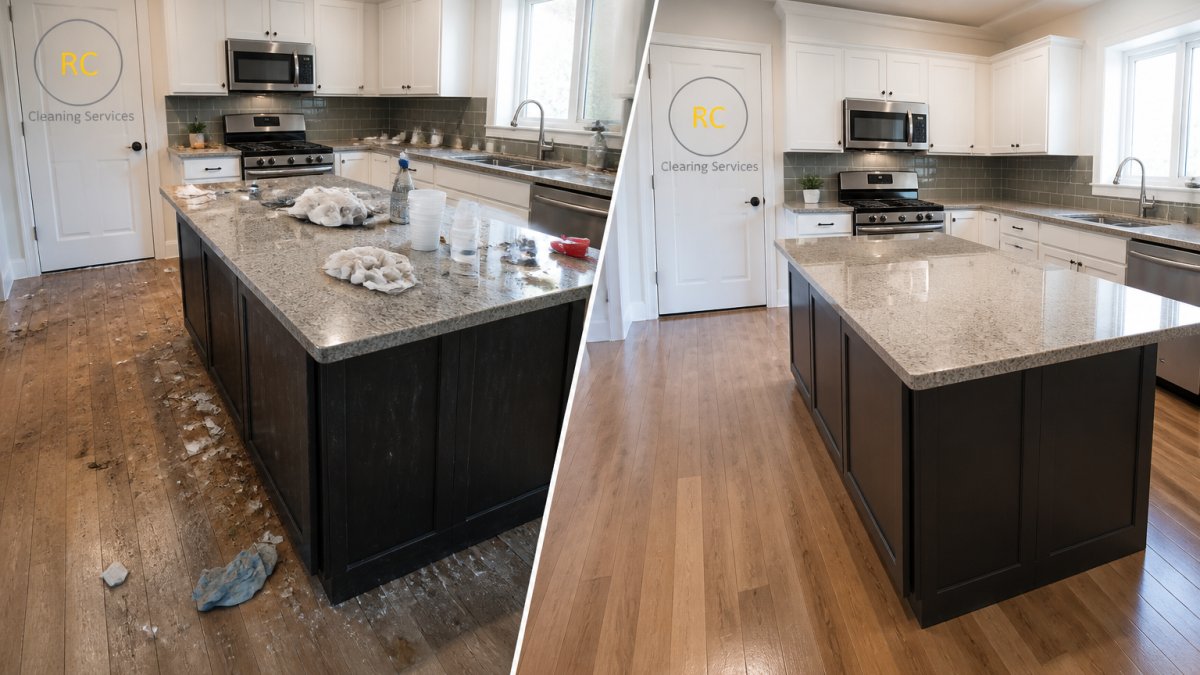
Rough cleaning is the first phase. This is where you remove large debris, dust surfaces heavily, and prepare the space for more detailed work.
Rough cleaning typically takes 20-40% of total project time. This phase includes:
Removing construction debris piles and scrap materials
Sweeping all floors and hard surfaces
Wiping down walls and removing visible dust
Cleaning windows and glass (exterior and interior)
Removing protective coverings and temporary materials
A standard crew of three workers can rough clean about 2,000-3,000 square feet per day. Larger spaces with heavy debris require slower progress.
Pro Tip Start rough cleaning immediately after construction ends. Dust settles on every surface within hours. The sooner you begin, the easier final cleaning becomes.
Fine Dust Removal and Surface Preparation
Fine dust removal is the second phase. Construction creates microscopic dust that coats everything, light fixtures, baseboards, door frames, and inside cabinets.
Fine dust removal typically takes 30-50% of total project time. This phase includes:
HEPA vacuuming all carpeted areas
Wiping baseboards, door frames, and trim
Cleaning light fixtures and ceiling fans
Dusting inside cabinets and closets
Wiping down appliances and fixtures
Cleaning hard-to-reach corners and ledges
Fine dust is persistent. Most teams need to pass through each room twice. The first pass captures visible dust. The second pass catches what the first pass missed.
Final Cleaning and Move-In-Ready Finishing
Final cleaning is the third phase. This is where you achieve the move-in-ready condition, spotless, polished, and ready for occupancy.
Final cleaning typically takes 20-30% of total project time. This phase includes:
Deep cleaning all floors (mopping, polishing, or shampooing)
Cleaning mirrors and windows to a shine
Wiping down all surfaces with appropriate cleaners
Trash removal and final walkthrough
Touch-ups and spot cleaning as needed
Final cleaning requires attention to detail. Missed spots under baseboards or fingerprints on light switches will be noticed immediately by new occupants.
How Long Does Post-Construction Cleaning Take by Property Size
Timeline estimates scale with square footage. A small residential property cleans faster than a sprawling commercial complex. But the relationship isn't linear, larger spaces don't take proportionally longer because teams can work more efficiently with better workflow.
Residential Properties: Square Footage and Room Count
For residential properties, estimate cleaning time based on square footage and room count.
Small residential property (1,000-1,500 sq ft, 2-3 bedrooms): 1-2 days with a 2-person crew
Medium residential property (1,500-3,000 sq ft, 3-4 bedrooms): 2-3 days with a 2-3 person crew
Large residential property (3,000-5,000 sq ft, 4+ bedrooms): 3-5 days with a 3-4 person crew
Residential properties clean faster than commercial spaces because they have less complex layouts and fewer fixtures. A single-family home with straightforward room layouts takes less time than a rambling ranch with multiple hallways and built-ins.
Room count matters more than square footage alone. A 2,000 square foot home with five small rooms takes longer to clean than a 2,000 square foot home with three large open spaces. More rooms mean more transitions, more baseboards, more corners.
Key Takeaway For residential properties, plan 1 day per 1,000-1,500 square feet. Add half a day for complex layouts or high-end finishes that require extra care.
Commercial Properties and Retail Spaces
Commercial properties take longer than residential properties of the same size. They have more fixtures, more complex layouts, and higher cleanliness standards.
Small commercial property (2,000-5,000 sq ft, single floor): 3-5 days with a 3-4 person crew
Medium commercial property (5,000-15,000 sq ft, multiple floors): 5-10 days with a 4-6 person crew
Large commercial property (15,000+ sq ft, multiple floors): 10-20 days with a 6-8 person crew
Commercial spaces include conference rooms, cubicles, bathrooms, break rooms, and entry areas. Each area requires different cleaning approaches. Carpet needs shampooing. Hard floors need polishing. Glass partitions need streak-free cleaning.
Retail stores present unique challenges. Display fixtures, shelving, and merchandise areas require careful cleaning. Dressing rooms need sanitizing. Checkout areas need detailed attention.
Construction Cleanup Labor Hours and Crew Size Calculations
The number of workers you deploy directly impacts timeline. More workers finish faster, but only to a point. Coordination becomes difficult with teams larger than 6-8 people on a single project.

Basic calculation: Multiply square footage by hours per 1,000 square feet, then divide by crew size.
For residential construction cleanup, plan 4-6 labor hours per 1,000 square feet. For commercial cleanup, plan 6-10 labor hours per 1,000 square feet.
A 3,000 square foot residential property needs approximately 12-18 labor hours total. A 2-person crew completes this in 6-9 days (assuming 2 hours of setup/breakdown daily). A 3-person crew completes it in 4-6 days.
Crew size affects more than just speed. Larger crews can tackle different areas simultaneously, reducing overall timeline. A 4-person crew can split into two teams and clean two sections at once.
Watch Out Avoid assigning crews larger than 6-8 people to a single project. Communication breaks down, quality inconsistencies emerge, and workers get in each other's way. Multiple smaller crews are more efficient than one massive team.
Commercial Post-Construction Cleaning Checklist and Task Sequencing
Proper sequencing prevents rework. Clean top-to-bottom and back-to-front. Dust falls down, so clean ceilings and high surfaces first. Work from the back of the building toward the exit so you don't walk through cleaned areas.
Phase 1: Rough Cleaning
Remove all construction debris and scrap materials
Sweep all floors thoroughly
Wipe down all walls and surfaces
Clean exterior and interior windows
Remove protective coverings and temporary materials
Vacuum or sweep HVAC vents and returns
Wipe door frames and door handles
Phase 2: Fine Dust Removal
HEPA vacuum all carpeted areas (first pass)
Wipe baseboards and trim throughout
Clean light fixtures and ceiling fans
Dust inside cabinets and closets
Wipe down appliances and built-in fixtures
Clean air vents and return registers
HEPA vacuum all carpeted areas (second pass)
Wipe high shelves and ledges
Phase 3: Final Cleaning
Mop all hard floors with appropriate cleaner
Polish or buff floors where needed
Clean mirrors and windows to a shine
Wipe all surfaces with final cleaner
Clean bathrooms (toilets, sinks, tubs)
Remove trash and debris
Final walkthrough and spot cleaning
Touch up any missed areas
Sequencing matters because dust from one task contaminates areas you've already cleaned. If you mop floors before removing fine dust, dust will settle on the wet floor. Always dust before mopping.
Timeline Estimation Formula and Real-World Examples
Here's a formula to estimate post-construction cleaning timelines:
Total Labor Hours = (Square Footage ÷ 1,000) × Hours Per 1,000 Sq Ft
Project Days = Total Labor Hours ÷ (Crew Size × Hours Per Day)
For residential properties, use 4-6 hours per 1,000 square feet. For commercial properties, use 6-10 hours per 1,000 square feet. Assume 8 working hours per day per crew member.
Single-Family Home Example: 3,500 Square Feet
A 3,500 square foot home with 4 bedrooms, 2 bathrooms, and moderate construction debris.
Calculation:
Square footage: 3,500
Hours per 1,000 sq ft (residential): 5 hours
Total labor hours: (3,500 ÷ 1,000) × 5 = 17.5 hours
Crew size: 3 workers
Hours per day: 8 hours
Project days: 17.5 ÷ (3 × 8) = 0.73 days per worker, or 2.4 days total
Estimated timeline: 2-3 days with a 3-person crew
This assumes moderate debris. If the home has extensive construction dust or complex finishes requiring extra care, add 1 day. If the home is relatively clean with minimal debris, subtract half a day.
Commercial Office Example: 10,000 Square Feet
A 10,000 square foot office space with open floor plan, multiple conference rooms, and two bathrooms.
Calculation:
Square footage: 10,000
Hours per 1,000 sq ft (commercial): 8 hours
Total labor hours: (10,000 ÷ 1,000) × 8 = 80 hours
Crew size: 4 workers
Hours per day: 8 hours
Project days: 80 ÷ (4 × 8) = 2.5 days
Estimated timeline: 2-3 days with a 4-person crew
Commercial offices often require more detailed work because of carpet shampooing, glass partition cleaning, and fixture polishing. This estimate assumes standard finishes. High-end offices with marble, special coatings, or extensive glazing may add 1-2 days.
Accounting for Rework and Repeat Cleaning
Construction cleanup rarely goes perfectly the first time. Dust settles after you finish. New areas become visible. Missed spots emerge during final walkthrough.
Plan for 10-15% rework time. A 3-day project should budget 3.3-3.5 days total. This gives you time to address missed areas without starting over completely.
Repeat cleaning is different from rework. Some spaces need a second pass through specific areas, particularly high-traffic zones that collect dust quickly. If a project has multiple phases or extended construction, plan for intermediate cleaning between phases.
Scheduling Buffers, Dependencies, and Contractor Coordination
Timeline estimates are starting points. Real projects need buffers for unexpected conditions.
Add scheduling buffers for these common issues:
Contractor delays in completing construction work
Discovery of additional debris or damage during cleaning
Weather delays (for exterior work)
Equipment or supply shortages
Rework requirements after inspection
Coordination with moving companies or new occupants
A realistic timeline adds 1-2 days to your estimate for a residential property and 2-3 days for a commercial property. This isn't pessimism, it's realism. Most projects encounter at least one unexpected condition.
Contractor coordination matters because construction teams often leave behind materials, equipment, or debris that cleaning crews can't remove. Confirm with the general contractor that the site is ready for cleaning before scheduling your crew.
Turnover coordination is critical for move-in-ready cleaning. Confirm the move-in date with the property manager or new occupant. Schedule cleaning to finish 1-2 days before occupancy.
Post-construction cleaning timelines depend on property size, debris level, and crew capacity. The estimation formula we use at RC Cleaning Services, LLC accounts for all three factors, giving you realistic timelines you can count on.
Frequently Asked Questions
How do you estimate post-construction cleaning time for a specific project?
Start with square footage and property type, then multiply by the phase duration per 1,000 square feet. For a 5,000-square-foot residential home, rough cleaning takes 2-3 days with a 3-person crew, fine dust removal takes 1-2 days, and final cleaning takes 2-3 days. Adjust based on debris level, floor count, and crew size. A professional walkthrough before the project confirms the scope and refines the estimate.
What factors affect how long does post-construction cleaning take?
Project scope (rough vs. final), square footage, property type (residential or commercial), debris level, floor count, number of fixtures and surfaces, crew size, and equipment availability all influence duration. A 2,000-square-foot residential property takes 5-7 days total with a standard crew; a 10,000-square-foot commercial space may take 10-14 days. Rework and repeat cleaning for missed spots add 1-2 days.
How many construction cleanup labor hours are typical for a move-in-ready cleaning?
A 3,000-square-foot home requires roughly 30-45 labor hours across all phases with a 3-person crew working 8-hour days. A 5,000-square-foot commercial property requires 60-90 labor hours. Multiply your square footage by 0.01-0.015 hours per square foot to estimate total labor. Larger crews reduce calendar days but increase total labor hours due to coordination overhead.
Should post-construction cleaning be done in one visit or multiple phases?
Multiple phases are standard: rough cleaning removes bulk debris, fine dust removal clears settled particles, and final cleaning prepares the space for occupancy. Splitting work across 3-5 days allows time for dust to settle and contractors to complete rework. Single-day cleaning is only realistic for very small spaces under 1,000 square feet with minimal debris.
BOOK ONLINE
Comments